Friday, 8 June 2012

Smell of Bread

Here is the text that introduces the Smell of Bread exhibition, on throughout June, 1st floor Nottingham Central Library.


‘The Smell of Bread’ is a simple phrase that binds many of us together. It carries with it the ideas of sustenance and comfort. For some, especially those who may be a long way from the country of their birth, it evokes a strong memory of home.
This and the other phrases, images and models in the exhibition have been created by ‘the international group’, a wonderful group of people from places as diverse as Syria, Palestine, China, Swaziland, Poland, Italy, Sudan, Zimbabwe, Swaziland, Turkey and of course Nottingham.
Through a series of highly inspiring workshops led by artists Jo Dacombe and Gillian Brent, participants explored the themes within the Thomas Demand and Decolonizing Architecture exhibition at Nottingham Contemporary.
The group discussed, debated and created artistic responses to the ideas of architecture and how the spaces in which we live can affect the ways in which we live. How do we create places that make us feel secure? How do changing boundaries impact on our lives? How do we begin to imagine and create shared spaces in which we are all equal?
The workshops also supported the group engaging more deeply with contemporary art, improving their artistic skills as well as their spoken and written English. We also hope that the project brought a new set of people together to begin to imagine a better world.
We would like to thank Sam Abbas, Zubeda Rasul, Dudu Bhembe, Tammy Tchi, Allan Njanji, Faisal Ballan, Shaista Khaliq, Banu Ozveri, Hoda Alfake, Samreen Zia, Edyta Frackowiak, Teresa Napiorkowska, and Dwain Bent for all their thoughtful contributions and artists Jo Dacombe and Gillian Brent for supporting and shaping their contributions all the way.
Working with Nottingham Contemporary   

Gill and I will be running workshops as part of a celebration to launch Refugee Week on 16th June at Nottingham Contemporary, drop in between 12 and 5pm.


Saturday, 2 June 2012

Dream Walking book published

I am very pleased to announce that our little book, Dream Walking: a Sidelong walk in Nottingham, is now available!

The book is 20 pages of writing and images by LJ and me about our first project collaborating as Sidelong. We wanted to record some of the ideas and thoughts behind the night walk we staged in Nottingham, so we decided to make this book, describing our influences, how we put the walk together and some of the ideas we had discussed as a collaboration. You can preview the book online here.

LJ and I have some more ideas about further walks we hope to stage together and we're talking right now about how to make them happen. I'm really excited about this, not only do I find LJ's ideas and enthusiasm refreshing, I am also discovering a lot more about Nottingham. Follow this blog, our Sidelong blog or follow the Sidelong Facebook page for updates on our future adventures! You can subscribe to this blog by email at the top left of this page to keep you informed of new posts.

We are interested in creating walks further afield than Nottingham too and have had a few interesting conversations over the past few months with people about possibilities, but so far this has not come to anything. If you know of somewhere interesting that we could explore for a walk, or would like to invite us to be part of an event, please get in touch or leave a comment below. We'd love to hear your ideas.

Wednesday, 23 May 2012

Smell of bread and little houses


Working towards the exhibition as a result of my work with my International Group at Nottingham Contemporary. We are calling the exhibition Smell of Bread, taken from something that one of the group wrote on their architectural piece.

The International Group have been wonderful to work with. Originating from places as diverse as Syria, Zimbabwe, Poland, China, India, Palestine, Georgia and more, the group have been working with me and another artist Gillian Brent for eight weeks.

We started by being inspired by the exhibitions at Nottingham Contemporary, at the time one of them was the Decolonizing Architecture exhibition that I've written about in two previous posts (Exploring Common Ground and Dividing Lines) Gill had an idea about using little wooden houses to create village layouts. I tried this with the group in one of our sessions.

With my interest in urban planning and social spaces I found this activity brilliant for generating debate and discussion about how we use spaces, how we build spaces and how those spaces then affect us.

We split into three groups and each group was given a set of wooden houses and a word. I asked them to create a village inspired by that word. Each group had similar sets of houses, but different words. The words were Secure, Shared and Nature.

Having created their villages, we then looked at each group's in turn. This simple activity turned into an hour and a half of debate and discussion about how we live: how space is shared, can we force people to share, can we police ourselves or do we always need an authority to make decisions? By building a secure space do we create elitism and exclude others? The shared space had similarities to the secure space - the shared space was only shared within the village and still excluded those outside the village, and the secure space was surrounded by a wall but still needed a shared space in the middle. Contact with the outside was made by the creation of a railway.

In contrast, the space created by the nature group was chaotic and anarchic, requiring constant negotiation between neighbours about who could use a space. At first this seemed attractive to many of us, but on closer inspection would this result in survival of the fittest? (or the most brutal?)

As discussions continued, people tried to re-order elements of their villages. Should civic buildings be central or on the outskirts? Could we have a space for shared faiths?

The theme for our project had been "Building a better future", and this activity really got deep into the issues about peoples living and sharing together as well as how we build.

Only a week later I came across a brilliant report of a lecture by Richard Sennett at Harvard, "The Architecture of Cooperation", discussing how people co-operate in spaces and how the spaces we plan affect this. He spoke about edges and boundaries, something our group has also talked a lot about.  Sennett suggested the need for a "membrane approach":
"In many planning classes, they say that when there is a rigid separation between two communities, classes, or functions, the best thing you can do is erase these divisions. This is an error. We need to mark space, and space has to have some quality of protection as well as opening to the outside: a membrane condition."
This inspired me to pick up a book on my bookshelf again, "The Social Logic of Space" by Hillier and Hanson, discussing "global-to-local logic", and the ideas of Durkheim who distinguished two types of social cohesion, or solidarity: organic and mechanical. Organic solidarity is based on the interdependence of peoples through difference, for example through the division of labour. Mechanical solidarity is based on integration through similarities such as belief and group structure.

These two types of social function require different types of space. Organic requires dense space, whereas mechanical organisations require segregated spaces.

Thinking all this through, I come back to the idea that we can plan our spaces to correspond to the way a society is working, however what happens when planners try to orchestrate the behaviour or social function of people by the way they plan the environment? I am reminded of my work some years ago for my Thinkspace project, when I met with architects of new school buildings who were trying to "design out" bad behaviour, and town planners who were redesigning housing areas that had disintegrated socially. At the time I made a speech as part of Architecture Week and I am reminded by the opening of the speech where I quoted Churchill:
"We shape our buildings; thereafter they shape us."
Yes, and the spaces between them too.

The Smell of Bread exhibition will be on show at Nottingham Central Library throughout June and a special celebration event will take place at Nottingham Contemporary on 16th June.

Tuesday, 15 May 2012

Winter into Spring


If you have been following my project to make a drawing each month, tracking the changes of nature by drawing the plants that I see on my walks, you will have noticed that there were no drawings for March.

Ah ha, given up already! you thought. Well, no, the drawings continued in March, but something had changed. It became Spring!

I was seduced by the snowdrops' tiny bowing heads, the early tree blossom, the blue of the hyacinths. Colour began to appear in scattered dots amongst the brown twigs. It was beautiful, promising, awakening and I loved it! But...

...the drawings stopped working. Depicting pretty spring flowers just wasn't doing it for me, it seemed too much like I was trying to be a botanical artist - which I'm not - rather than to do what I'm interested in. It took me the month of March to figure it out.

The drawings in winter worked because of the lack of colour. Lacking leaves or the softness of petals, the winter twigs topped with rose hips and the cones hanging like tarnished earrings from the hazel were all about structure and line. I had written the previous autumn (when walking by the river) about the architecture of plants, resulting in my drawings of teasel, thistle and hawthorn berries. This was what was missing in the drawings in March.


Too much colour, pretty flowers, blousey petals - I was seduced by them and lost the idea of the structures. I had to rethink.

In May, I made a drawing of a bunch of pink blossom from a tree lining a road near where I live. A remarkable colour, but I needed another approach. Having made a drawing in pencil, I realised that for a long time I had really loved the linear quality of the drawings, and this was part of the tracing of the shapes. With the blossom, the linear drawing was about working out how the petals, stamen and stem all fitted together. I decided to go further with the linear quality and make the drawing as a linocut.

I carved the lines detailed and thin into the lino, to give the impression of the delicate quality of the blossom, but also to emphasise the intricate linear quality of the drawing that I loved. Printing the image in pale pink onto a grey paper kept the subtlety and prettyness of the blossom, but revealed the thread-like lines of the structure.


It feels like I'm back on track. It will be interesting to see how these develop throughout the year as the seasons change and throw up new challenges for me! But for now I will keep pursuing that linear quality and see where it takes me.

It's also interesting how, having decided to focus on line and structure, my perception of the world has shifted slightly too. I'm noticing more of the linear qualities around me, not just in nature but in other things too: cracks in walls, snail trails across slabs, the rhythms of fencing. What we see feeds the art and the art feeds what we see.

I'm collecting some of the drawings and prints in my shop, click here to see them.

Also, you can now follow me on my new Facebook page.

Thursday, 26 April 2012

Riverlands and Spires

The premiere of Riverlands, a performance by Jo Bell and Jo Blake Cave, took place at Aldwincle All Saints Church in Northamptonshire, with the artwork by me and Kate Dyer on display.

Photo by Kate Dyer
The event was mesmerising, the venue magical, lit by technician Andy Eathorne to create gently rippling coloured light across the columns, evoking the animation of light on water.

The performance was rich with romance, humour, characters and birds. The audience (sold out on the first night!) were riveted from start to finish, not a sound or a stir until the double encore at the end.

I had worked with Kate Dyer to create artwork that incorporated my maps and drawings with Kate's photographs from the river. This had been a challenge as my drawings are linear and delicate with limited colour, whereas Kate's images were rich in colour and texture. Making them work together on one piece was a challenge! However, once I struck on the idea that the map was all about the shape of the river rather than the elements around it, this resulted in Kate's images also working with the shape of the river and creating the impressions of colour and texture that you experience on the banks.


I included my sketches and notes from the river on the reverse of the map. The drawings were received really well and I had some great feedback from the audience. This is particularly encouraging as I have just launched my shop of drawings for a personal project I have been doing, originally inspired by this commission.


I created an extra addition to the project, the Church Spires cutouts. My sense of travelling on the river was punctuated by the appearance of church spires slicing into the sky, so surprising when juxtaposed with the horizontal planes of the river. The spires along this stretch of river were significant to my experience and I wanted to find a way to include them.


The Church Spires cutouts is a set of unfolded spires, a selection of the shapes that I saw from the river. The spires are an A4 sheet of quality card laser cut to produce 5 shapes. When pressed out and folded, the shapes create miniature spire shapes.

These were really popular at the event and I sold quite a few. It's the first time I have worked with laser cutting and I was delighted with the results. Folded paper, paper forms and working with 2D into 3D is something that has interested me for a long time, so I will definitely be doing more laser cut paper sculptures in the future.


To see the map, drawings and Church Spires cutouts in more detail, click here.

Riverlands and the River map were commissioned by Rosalind Stoddart, Cultural Engineer.

Tuesday, 17 April 2012

The Psychogeography of Standing Stones


Having returned from a week walking on Dartmoor, which included a number of visits to standing stones, I am once again reminded of the very specific sitings that ancient standing stones have.

Whether  you believe in things like ley lines or geographical vortices of power or not, there is definitely something about the locations that the ancients chose for their standing stones which inspire in us an imaginative power and mystery.

Dartmoor is spectacular, particularly in our overcrowded little island, as a place of miles of nothingness... one can walk for several leagues without meeting a road or building or, indeed, another person. It is always in these places, it seems to me, that birds take over as the dominant species - remove humans and birds move right in, coming and going in their flux of settlement and migration. Buzzards whirled overhead, appearing and reappearing day by day. A peregrine swooped below us as we stood on one of the high tors. A kestrel hanging in the air, that distinctive shape, before making his dive. Crows wheeling everywhere.

Beardown Man is a menhir, isolated, twice as tall as a man, that stands between the tors. He appears to be surveying the hills. His vertical presence on the endless horizontal planes of the moor is remarkable, and seems to draw attention to the horizons. You can see the weather coming towards you from all points of the compass. His presence seems to draw you to consider your surroundings.

It is quite a walk to Beardown Man, as there is only one road that really crosses Dartmoor, so to get anywhere you have to go by foot across boggy, grass tufted land. Many standing stones in Britain are more accessible now, but there are still a number like this that require effort to reach. Often high up on hills, isolated, placed in the centre of open, empty landscapes, the stones require a sort of pilgrimage to reach them. This must be how the ancients intended them to be, before we built roads to access pretty much everything. The effort of reaching the stones adds to their singularity.

Did they wish to place a stone and so sought the right place for it? Or did being in the place itself suggest a stone should be uprighted there.

It made me wonder, where would we place standing stones today? And what would they mean now, given our changed and constantly altering landscape, how would the surroundings interact imaginatively with that extraordinary presence?

Saturday, 24 March 2012

Dividing lines

Friday was a big celebration day at Nottingham Contemporary, showcasing the work of 12 schools that have been working with the Associate Artists over the last year.

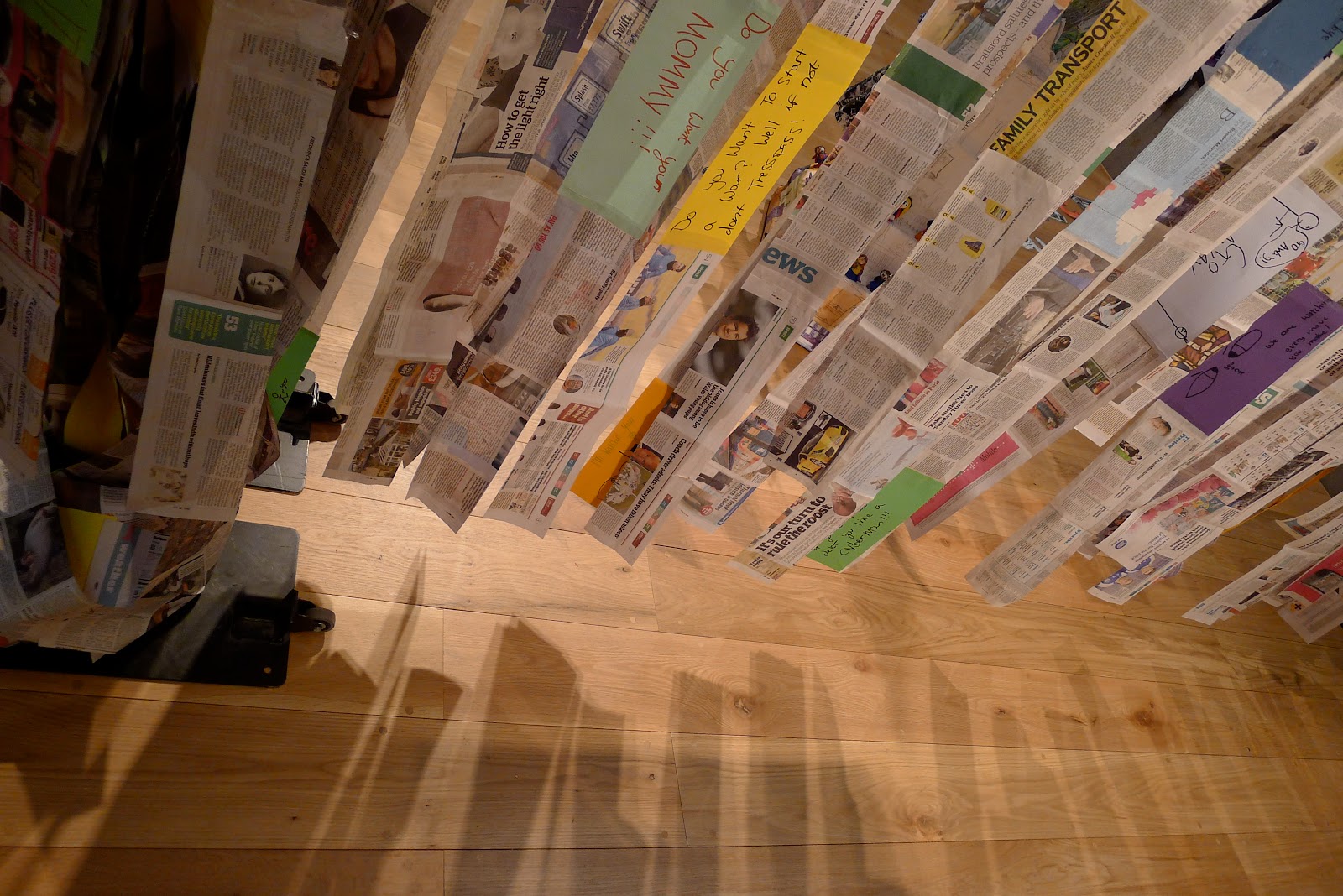
Inspired by the DAAR exhibition, I have been working with Heathfield Primary School. As part of our project they held a "Line Day" - they drew a line right through the school for one day, with masking tape, and then hung newspaper streamers above it, appearing like an 8 foot wall towering above them.


Some of the children became trapped on one side of the wall, some trapped on the other side. They had to stay like this all day, without crossing the line.

At the end of the day they made a film about the experience, which was shown at the celebration event. How had the line made them feel?

DAAR's exhibition is all about borders and territory, a study of architecture in Israel / Palestine where borders are contested and the exhibition tries to imagine different futures for the building and territories there. The Line Day at the school helped the children to understand the reality of this kind of conflict. This is experiential art, where the children have an experience about an idea, rather than passively looking at representations of an idea in a gallery. The results were profound.


For the film each child's face appears for a brief moment, cropped close and staring at the viewer directly, the line hanging behind them. There is something about these serious, sincere faces of children that are incredibly engaging. The children each say a few words, sometimes only one word, to describe their reflections of the event. "Despondent", "depressed", followed by shouting, "angry", "frustrated!" "It's splitting up friendships", "it's just not fair" says a boy. "But I've done nothing wrong!" pleads a girl.

This simple act created a film that I found incredibly moving. These children expressed deep understanding of the results of conflicting borders on peoples. It was also courageous of the school to take on the experiment, often so difficult for schools to step outside their own constraints of the curriculum.


750 school children visited the exhibition on Friday, and it stayed open today for the general public. I'm really proud of everything they have achieved. All 12 schools had made remarkable and thought provoking work.