Thursday, 26 April 2012

Riverlands and Spires

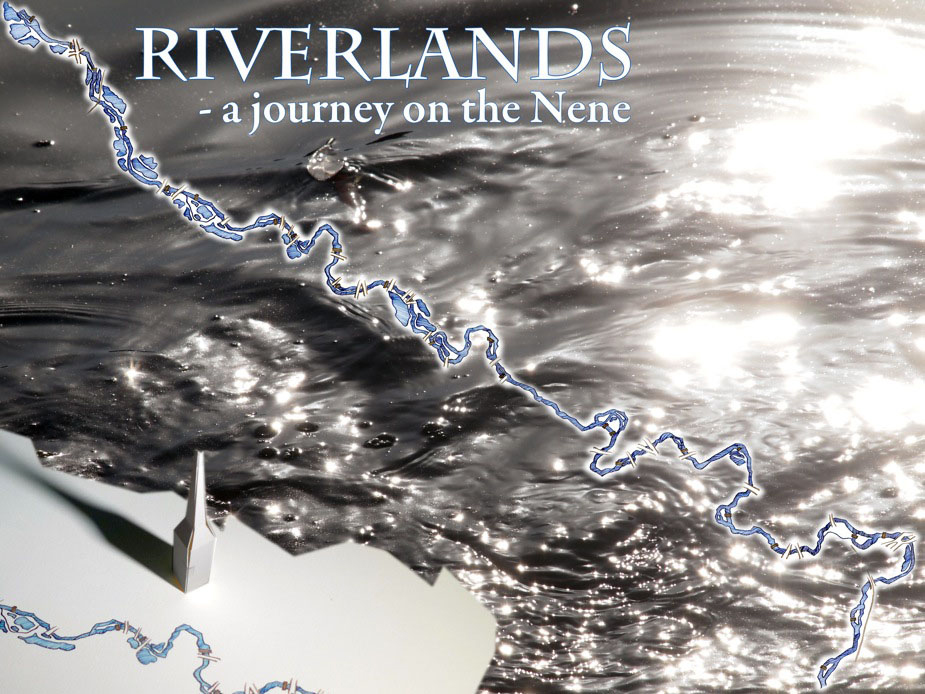
The premiere of Riverlands, a performance by Jo Bell and Jo Blake Cave, took place at Aldwincle All Saints Church in Northamptonshire, with the artwork by me and Kate Dyer on display.

Photo by Kate Dyer
The event was mesmerising, the venue magical, lit by technician Andy Eathorne to create gently rippling coloured light across the columns, evoking the animation of light on water.

The performance was rich with romance, humour, characters and birds. The audience (sold out on the first night!) were riveted from start to finish, not a sound or a stir until the double encore at the end.

I had worked with Kate Dyer to create artwork that incorporated my maps and drawings with Kate's photographs from the river. This had been a challenge as my drawings are linear and delicate with limited colour, whereas Kate's images were rich in colour and texture. Making them work together on one piece was a challenge! However, once I struck on the idea that the map was all about the shape of the river rather than the elements around it, this resulted in Kate's images also working with the shape of the river and creating the impressions of colour and texture that you experience on the banks.


I included my sketches and notes from the river on the reverse of the map. The drawings were received really well and I had some great feedback from the audience. This is particularly encouraging as I have just launched my shop of drawings for a personal project I have been doing, originally inspired by this commission.


I created an extra addition to the project, the Church Spires cutouts. My sense of travelling on the river was punctuated by the appearance of church spires slicing into the sky, so surprising when juxtaposed with the horizontal planes of the river. The spires along this stretch of river were significant to my experience and I wanted to find a way to include them.


The Church Spires cutouts is a set of unfolded spires, a selection of the shapes that I saw from the river. The spires are an A4 sheet of quality card laser cut to produce 5 shapes. When pressed out and folded, the shapes create miniature spire shapes.

These were really popular at the event and I sold quite a few. It's the first time I have worked with laser cutting and I was delighted with the results. Folded paper, paper forms and working with 2D into 3D is something that has interested me for a long time, so I will definitely be doing more laser cut paper sculptures in the future.


To see the map, drawings and Church Spires cutouts in more detail, click here.

Riverlands and the River map were commissioned by Rosalind Stoddart, Cultural Engineer.

Tuesday, 17 April 2012

The Psychogeography of Standing Stones


Having returned from a week walking on Dartmoor, which included a number of visits to standing stones, I am once again reminded of the very specific sitings that ancient standing stones have.

Whether  you believe in things like ley lines or geographical vortices of power or not, there is definitely something about the locations that the ancients chose for their standing stones which inspire in us an imaginative power and mystery.

Dartmoor is spectacular, particularly in our overcrowded little island, as a place of miles of nothingness... one can walk for several leagues without meeting a road or building or, indeed, another person. It is always in these places, it seems to me, that birds take over as the dominant species - remove humans and birds move right in, coming and going in their flux of settlement and migration. Buzzards whirled overhead, appearing and reappearing day by day. A peregrine swooped below us as we stood on one of the high tors. A kestrel hanging in the air, that distinctive shape, before making his dive. Crows wheeling everywhere.

Beardown Man is a menhir, isolated, twice as tall as a man, that stands between the tors. He appears to be surveying the hills. His vertical presence on the endless horizontal planes of the moor is remarkable, and seems to draw attention to the horizons. You can see the weather coming towards you from all points of the compass. His presence seems to draw you to consider your surroundings.

It is quite a walk to Beardown Man, as there is only one road that really crosses Dartmoor, so to get anywhere you have to go by foot across boggy, grass tufted land. Many standing stones in Britain are more accessible now, but there are still a number like this that require effort to reach. Often high up on hills, isolated, placed in the centre of open, empty landscapes, the stones require a sort of pilgrimage to reach them. This must be how the ancients intended them to be, before we built roads to access pretty much everything. The effort of reaching the stones adds to their singularity.

Did they wish to place a stone and so sought the right place for it? Or did being in the place itself suggest a stone should be uprighted there.

It made me wonder, where would we place standing stones today? And what would they mean now, given our changed and constantly altering landscape, how would the surroundings interact imaginatively with that extraordinary presence?

Saturday, 24 March 2012

Dividing lines

Friday was a big celebration day at Nottingham Contemporary, showcasing the work of 12 schools that have been working with the Associate Artists over the last year.

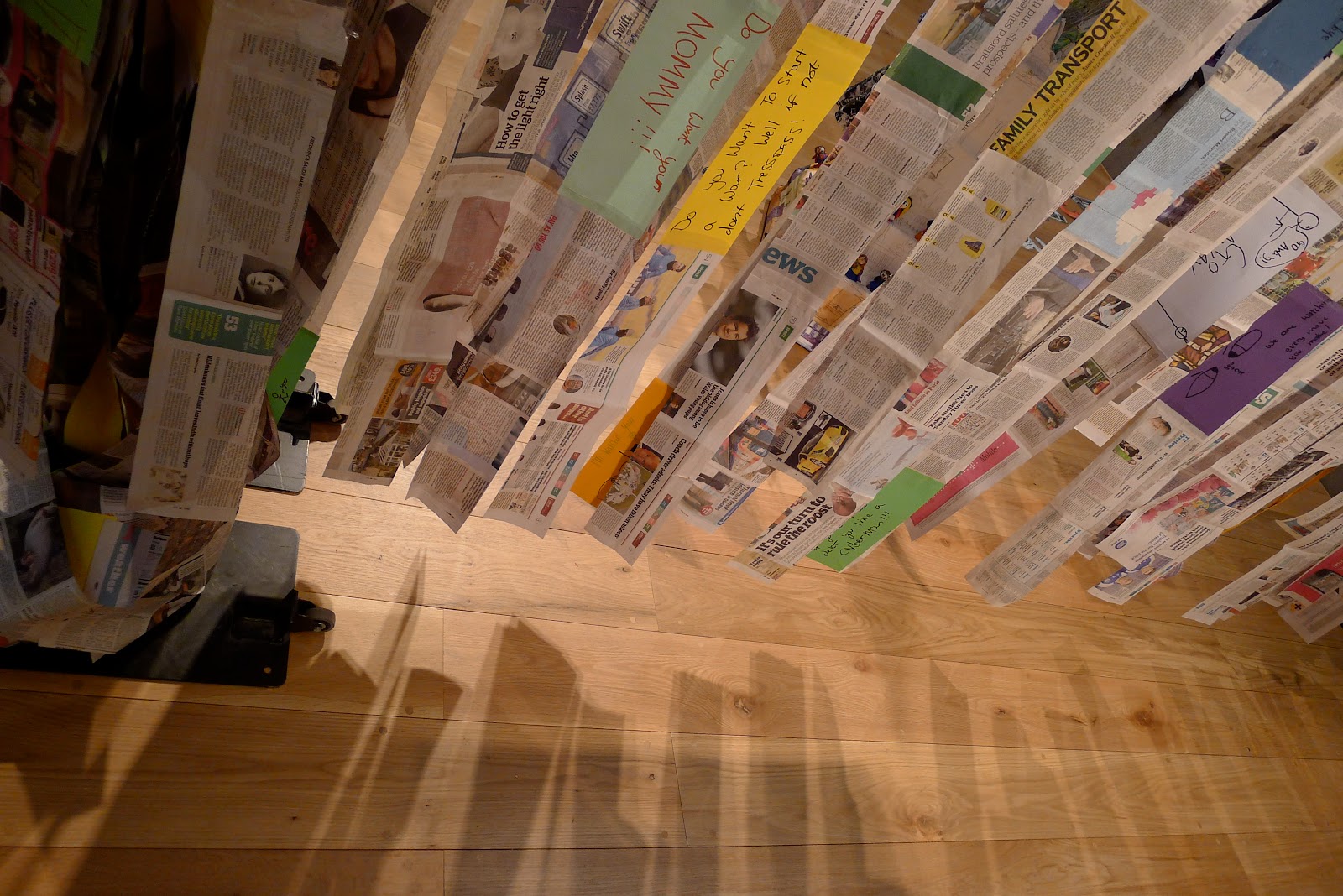
Inspired by the DAAR exhibition, I have been working with Heathfield Primary School. As part of our project they held a "Line Day" - they drew a line right through the school for one day, with masking tape, and then hung newspaper streamers above it, appearing like an 8 foot wall towering above them.


Some of the children became trapped on one side of the wall, some trapped on the other side. They had to stay like this all day, without crossing the line.

At the end of the day they made a film about the experience, which was shown at the celebration event. How had the line made them feel?

DAAR's exhibition is all about borders and territory, a study of architecture in Israel / Palestine where borders are contested and the exhibition tries to imagine different futures for the building and territories there. The Line Day at the school helped the children to understand the reality of this kind of conflict. This is experiential art, where the children have an experience about an idea, rather than passively looking at representations of an idea in a gallery. The results were profound.


For the film each child's face appears for a brief moment, cropped close and staring at the viewer directly, the line hanging behind them. There is something about these serious, sincere faces of children that are incredibly engaging. The children each say a few words, sometimes only one word, to describe their reflections of the event. "Despondent", "depressed", followed by shouting, "angry", "frustrated!" "It's splitting up friendships", "it's just not fair" says a boy. "But I've done nothing wrong!" pleads a girl.

This simple act created a film that I found incredibly moving. These children expressed deep understanding of the results of conflicting borders on peoples. It was also courageous of the school to take on the experiment, often so difficult for schools to step outside their own constraints of the curriculum.


750 school children visited the exhibition on Friday, and it stayed open today for the general public. I'm really proud of everything they have achieved. All 12 schools had made remarkable and thought provoking work.

Saturday, 17 March 2012

New connections unfolding...

It was great to meet Brian Lewis at Sates of Independence today, a free book fair of independent publishers, held in Leicester.

Brian is editor and publisher of Longbarrow Press. His stall attracted me immediately, layed out with numerous handmade pamphlets and CDs of a variety of formats. More like artist's books than publications, each one is hand crafted by Brian and produced on beautiful papers, the whole stall given an elegant and understated look of neutral colours, greys, browns, creams, with paper textures a delight to hold between your fingers. I talked for a long time with Brian about our mutual interests. As Longbarrow state on their website:

The ethos governing the output of the press is that the poem should dictate the format of publication. The resulting objects – matchboxes, acetates, maps – allow poet and publisher to explore alternatives to the book without resorting to gimmickry.

This is so apparent in the resulting work. Brian showed me a matchbox he had made which opens to reveal 56 pages of a poem concertinaed into the box. He had CDs covered with brown paper, half the size of the usual CD. Their surprising smallness was delightful. I particularly liked "Edgelands", a publication printed in a long, thin format, about the size of a bookmark.

I went to the event on the suggestion of Mark Goodwin, a poet published by Longbarrow. Mark and I have been talking recently about possible collaborative work. I worked with Mark once before on the Companion Stones project. We created a stone together, with Mark's words and my form, and from the outset we were interested in how the words and the form could work together. Mark's words evoked the sense of horizons in the site where the stone now stands, in the Peak District. My design was two blocks, one on top of the other, but one twisted away, to give the impression of the stones turning. Mark's words are carved into the edges of the stones, splitting the words at the corners, so that they can be read in different ways - as a full poem, if you read it by walking around and around the 'turning' stones, or as broken words and fragments on the faces of the stone. (See the stone and its location here.)
Model of St Peters & St Andrews Church, Corby

Talking to Brian about the form of the publication being inspired by the poem, I was reminded of the Companion Stones project and also of my interest in creating forms from paper. My current project, for the River Nene (see Riverlands event), also involves the use of folded paper forms. I created a number of forms as part of my project with St Peter's and St Andrew's Church a few years ago (working with artist Carole Miles, and that collaboration now continues in a new form as undiscoverednetworks!). As I was exploring the architecture of the church, I began to make models of the church hall and its distinctive use of the tetrahedron for its spires. I was fascinated by the shapes created when the architecture was unfolded back into a flat piece of paper. I wanted to make the church from one sheet, so it unfolded and folded like a box.

I still really like the flat and then three dimensional possibilities of paper, and I think working with Mark, poetry and paper shapes will be worthy of more exploration.

One of the results of our exploration of the tetrahedrol architecture of St Peters and St Andrews Church is currently on display as part of the Corby Open, until 31st March, click here for details.

Wednesday, 7 March 2012

Riverlands


Riverlands - a journey on the Nene
Saturday, April 21, 2012 from 7:30 pm - 8:30 pm
Sunday, April 22, 2012 from 7:30 pm - 8:30 pm

All Saints Church, Thorpe Road, Aldwincle, NN14 3EA

BUY TICKETS HERE

Riverlands - a journey on the Nene - Rosalind Stoddart

The national premiere of a performance by poet Jo Bell and storyteller Jo Blake Cave.
Inspired by their journey along the Nene in the footsteps of nature writer BB, this hour-long performance brings you atmosphere, mesmerising stories, humour and humanity.

This evening will also mark the first availability of:
ALWALTON - WOLLASTON
A visual response to our journey on the Nene by Jo Dacombe ad Kate Dyer.
A limited edition will be for sale at this performance.

TICKETS:
General Admission: £10
Concessions (senior citizens, students and unemployed): £8
(includes £2 donation to The Churches Conservation Trust)
If event is not sold out, tickets will be available on the door.

For further information please contact:
Rosalind Stoddart
01536 370108
ros@rosalindstoddart.co.uk
www.rosalindstoddart.co.uk

Supporters of Riverlands project - Rosalind Stoddart

Thursday, 1 March 2012

Busy writing...

I have been busy writing blog posts for Creative Nottingham, I've listed the latest ones below.

I've also started putting some of my favourite photographs from my various walks on a new page, click on the Photographs link above.

And I've started work on two new books about walking - coming soon!

Creative Nottingham Guest Blog - Photographing Architecture

Creative Nottingham Guest Blog - A Sidelong walk along the canal

Saturday, 18 February 2012

The Colour of a Walk


One of the options I considered when thinking about the map I am making for the River Nene was to trace the colours along the river.

As I boated, canoed and walked along the river last summer and into the autumn, it became apparent to me that different parts of this river had their own overall distinct colours.  The Higham Ferrers end has the remnants of an industrial history and there are glimpses of concrete greys and rusted irons here and there.  As you get towards the villages of Fotheringhay and Wadenhoe the colours change to a more dominant stone colour of the buildings, with blasts of bright yellow rape fields.

I rejected this idea in favour of other considerations for the river map (to be unveiled in April at the Riverlands performance), however I am keeping the idea of mapping the colours of a walk for another day.

----------------------------------------------------------------------------------------------------

I have been blogging all over the place this week, here is a round up of other writings:

I wrote my first Guest Blog - Dream Walking for Light Night, for Creative Nottingham;

I started describing the idea behind each of the images in our Dream Walk on the Sidelong blog, and photos of the glowing images installed on the night can be seen on our Facebook page;

and an article on one of my workshops at Nottingham Contemporary appeared in the Nottingham Evening Post:  Pupil's eyes opened to the challenge of modern art.