Saturday, 24 March 2012

Dividing lines

Friday was a big celebration day at Nottingham Contemporary, showcasing the work of 12 schools that have been working with the Associate Artists over the last year.

Inspired by the DAAR exhibition, I have been working with Heathfield Primary School. As part of our project they held a "Line Day" - they drew a line right through the school for one day, with masking tape, and then hung newspaper streamers above it, appearing like an 8 foot wall towering above them.
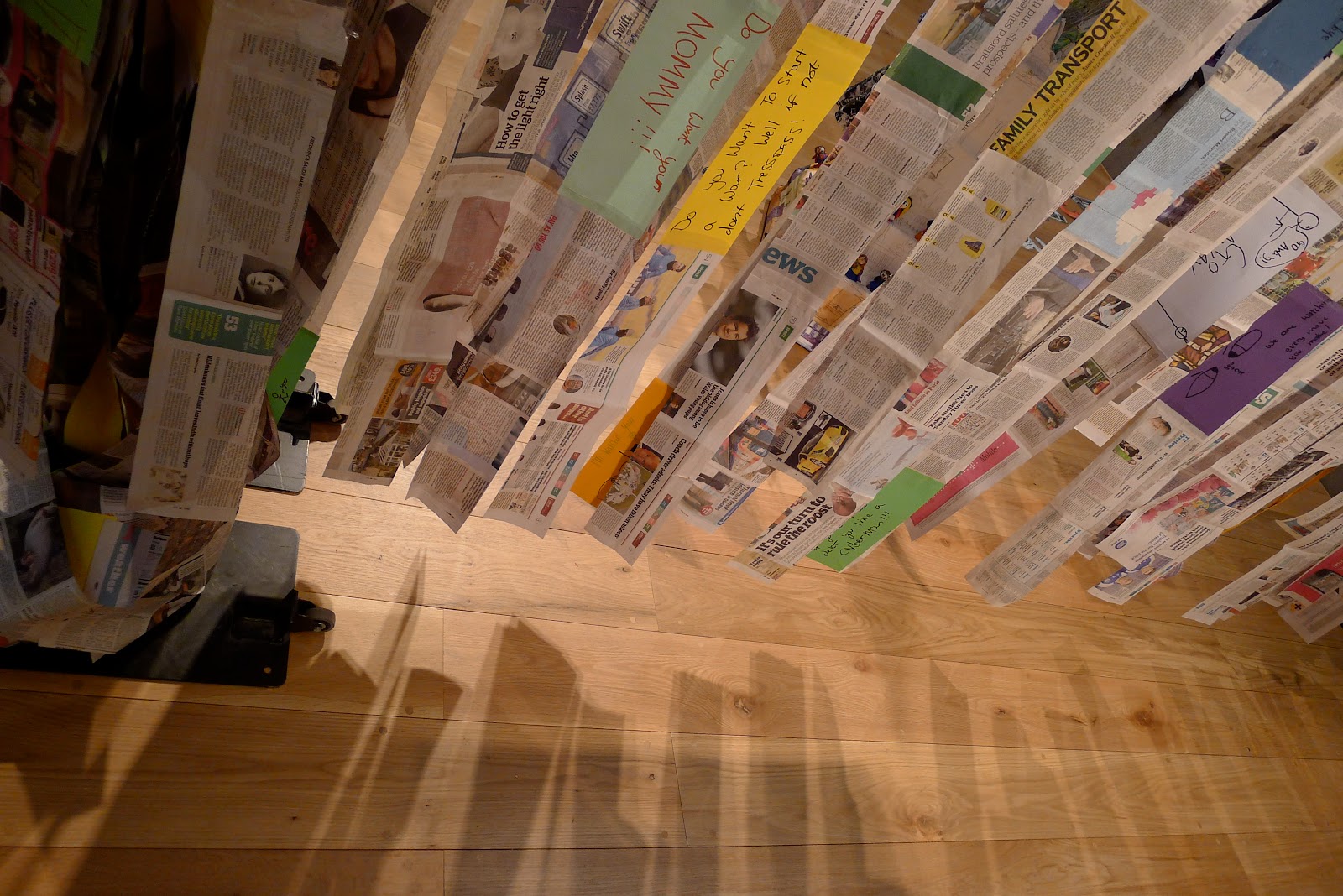

Some of the children became trapped on one side of the wall, some trapped on the other side. They had to stay like this all day, without crossing the line.

At the end of the day they made a film about the experience, which was shown at the celebration event. How had the line made them feel?

DAAR's exhibition is all about borders and territory, a study of architecture in Israel / Palestine where borders are contested and the exhibition tries to imagine different futures for the building and territories there. The Line Day at the school helped the children to understand the reality of this kind of conflict. This is experiential art, where the children have an experience about an idea, rather than passively looking at representations of an idea in a gallery. The results were profound.


For the film each child's face appears for a brief moment, cropped close and staring at the viewer directly, the line hanging behind them. There is something about these serious, sincere faces of children that are incredibly engaging. The children each say a few words, sometimes only one word, to describe their reflections of the event. "Despondent", "depressed", followed by shouting, "angry", "frustrated!" "It's splitting up friendships", "it's just not fair" says a boy. "But I've done nothing wrong!" pleads a girl.

This simple act created a film that I found incredibly moving. These children expressed deep understanding of the results of conflicting borders on peoples. It was also courageous of the school to take on the experiment, often so difficult for schools to step outside their own constraints of the curriculum.


750 school children visited the exhibition on Friday, and it stayed open today for the general public. I'm really proud of everything they have achieved. All 12 schools had made remarkable and thought provoking work.

Saturday, 17 March 2012

New connections unfolding...

It was great to meet Brian Lewis at Sates of Independence today, a free book fair of independent publishers, held in Leicester.

Brian is editor and publisher of Longbarrow Press. His stall attracted me immediately, layed out with numerous handmade pamphlets and CDs of a variety of formats. More like artist's books than publications, each one is hand crafted by Brian and produced on beautiful papers, the whole stall given an elegant and understated look of neutral colours, greys, browns, creams, with paper textures a delight to hold between your fingers. I talked for a long time with Brian about our mutual interests. As Longbarrow state on their website:

The ethos governing the output of the press is that the poem should dictate the format of publication. The resulting objects – matchboxes, acetates, maps – allow poet and publisher to explore alternatives to the book without resorting to gimmickry.

This is so apparent in the resulting work. Brian showed me a matchbox he had made which opens to reveal 56 pages of a poem concertinaed into the box. He had CDs covered with brown paper, half the size of the usual CD. Their surprising smallness was delightful. I particularly liked "Edgelands", a publication printed in a long, thin format, about the size of a bookmark.

I went to the event on the suggestion of Mark Goodwin, a poet published by Longbarrow. Mark and I have been talking recently about possible collaborative work. I worked with Mark once before on the Companion Stones project. We created a stone together, with Mark's words and my form, and from the outset we were interested in how the words and the form could work together. Mark's words evoked the sense of horizons in the site where the stone now stands, in the Peak District. My design was two blocks, one on top of the other, but one twisted away, to give the impression of the stones turning. Mark's words are carved into the edges of the stones, splitting the words at the corners, so that they can be read in different ways - as a full poem, if you read it by walking around and around the 'turning' stones, or as broken words and fragments on the faces of the stone. (See the stone and its location here.)
Model of St Peters & St Andrews Church, Corby

Talking to Brian about the form of the publication being inspired by the poem, I was reminded of the Companion Stones project and also of my interest in creating forms from paper. My current project, for the River Nene (see Riverlands event), also involves the use of folded paper forms. I created a number of forms as part of my project with St Peter's and St Andrew's Church a few years ago (working with artist Carole Miles, and that collaboration now continues in a new form as undiscoverednetworks!). As I was exploring the architecture of the church, I began to make models of the church hall and its distinctive use of the tetrahedron for its spires. I was fascinated by the shapes created when the architecture was unfolded back into a flat piece of paper. I wanted to make the church from one sheet, so it unfolded and folded like a box.

I still really like the flat and then three dimensional possibilities of paper, and I think working with Mark, poetry and paper shapes will be worthy of more exploration.

One of the results of our exploration of the tetrahedrol architecture of St Peters and St Andrews Church is currently on display as part of the Corby Open, until 31st March, click here for details.

Wednesday, 7 March 2012

Riverlands


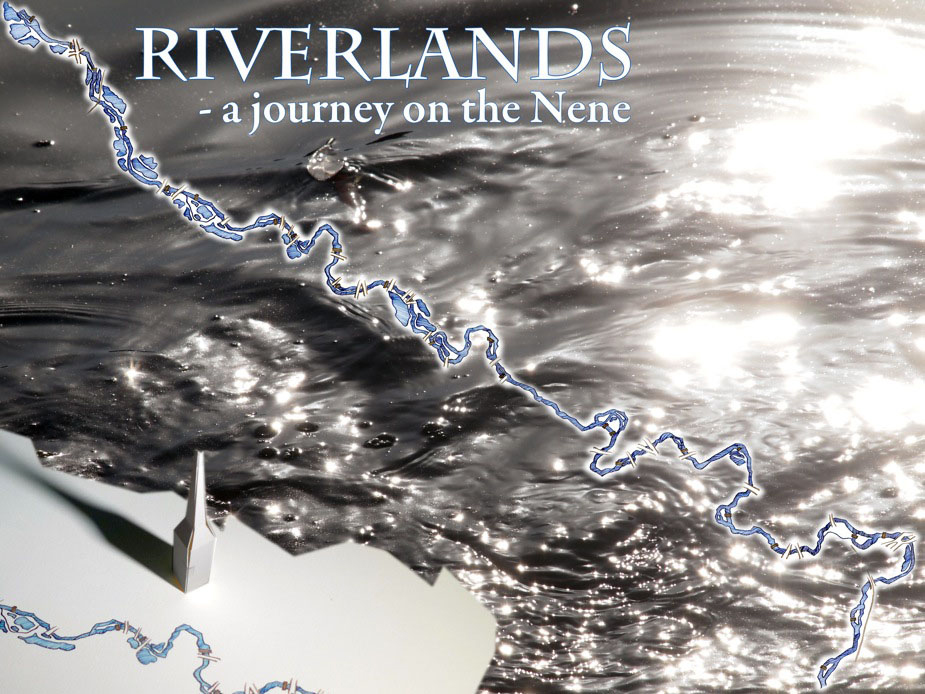
Riverlands - a journey on the Nene
Saturday, April 21, 2012 from 7:30 pm - 8:30 pm
Sunday, April 22, 2012 from 7:30 pm - 8:30 pm

All Saints Church, Thorpe Road, Aldwincle, NN14 3EA

BUY TICKETS HERE

Riverlands - a journey on the Nene - Rosalind Stoddart

The national premiere of a performance by poet Jo Bell and storyteller Jo Blake Cave.
Inspired by their journey along the Nene in the footsteps of nature writer BB, this hour-long performance brings you atmosphere, mesmerising stories, humour and humanity.

This evening will also mark the first availability of:
ALWALTON - WOLLASTON
A visual response to our journey on the Nene by Jo Dacombe ad Kate Dyer.
A limited edition will be for sale at this performance.

TICKETS:
General Admission: £10
Concessions (senior citizens, students and unemployed): £8
(includes £2 donation to The Churches Conservation Trust)
If event is not sold out, tickets will be available on the door.

For further information please contact:
Rosalind Stoddart
01536 370108
ros@rosalindstoddart.co.uk
www.rosalindstoddart.co.uk

Supporters of Riverlands project - Rosalind Stoddart

Thursday, 1 March 2012

Busy writing...

I have been busy writing blog posts for Creative Nottingham, I've listed the latest ones below.

I've also started putting some of my favourite photographs from my various walks on a new page, click on the Photographs link above.

And I've started work on two new books about walking - coming soon!

Creative Nottingham Guest Blog - Photographing Architecture

Creative Nottingham Guest Blog - A Sidelong walk along the canal

Saturday, 18 February 2012

The Colour of a Walk


One of the options I considered when thinking about the map I am making for the River Nene was to trace the colours along the river.

As I boated, canoed and walked along the river last summer and into the autumn, it became apparent to me that different parts of this river had their own overall distinct colours.  The Higham Ferrers end has the remnants of an industrial history and there are glimpses of concrete greys and rusted irons here and there.  As you get towards the villages of Fotheringhay and Wadenhoe the colours change to a more dominant stone colour of the buildings, with blasts of bright yellow rape fields.

I rejected this idea in favour of other considerations for the river map (to be unveiled in April at the Riverlands performance), however I am keeping the idea of mapping the colours of a walk for another day.

----------------------------------------------------------------------------------------------------

I have been blogging all over the place this week, here is a round up of other writings:

I wrote my first Guest Blog - Dream Walking for Light Night, for Creative Nottingham;

I started describing the idea behind each of the images in our Dream Walk on the Sidelong blog, and photos of the glowing images installed on the night can be seen on our Facebook page;

and an article on one of my workshops at Nottingham Contemporary appeared in the Nottingham Evening Post:  Pupil's eyes opened to the challenge of modern art.

Saturday, 11 February 2012

Curating: weaving the Dream Walk

Design for Dream Walking intervention
Friday saw the first curated walk put together by LJ and me, working as Sidelong, take place as part of Nottingham's Light Night festival.

Overall it was a great success, with over 160 people taking part, despite below freezing temperatures.  Time, then, for some reflections on curating walks.
LJ giving out maps at our stall

LJ and I wanted to think about the notion of a curated walk.  How would that work? What does it mean to curate a walk?  Our Sidelong projects aim to explore different ways of answering that question.

We started working on our walk in Nottingham back in November.  We started to devise the route by taking a dérive (see the translation of Debord's original writing on the Theory of the Dérive at the Bureau of Public Secrets)  - a wander through the streets with no destination in mind, letting the city itself suggest the route and pulling us towards places of interest.  We felt that for the walk to be truly curated, we should allow for a meeting between what the city offered us and how we organised that imaginatively into a route with cohesive meaning.


Daryl Bank questioned what a curator actually does, suggesting that the definition of a curator has broadened and become hard to pin down.  "In its broadest terms, the curator is an active producer of meaning. In the context of an exhibition, that meaning can be produced through their bringing together of works of art, or artists, and their development of a framework or a context through which those works can be viewed."

I asked LJ the same question, when we first started talking about collaborating.  She felt that a curator should somehow create new narratives.  We had a number of ideas, including how we might weave together narratives or meanings and engage audiences in those, but also how audiences themselves should be brought into creating their own meaning through engaging with our work.


In the Nottingham walk, Dream Walking, we did find a narrative or framework of meaning that suggested itself.  Our dérive began to draw links between different buildings and images in the streets.  There were numerous references to angels - the Old Angel Inn, images of cherubs on moved gravestones, Office Angels, and so on.  There were a number of birds also, carved into buildings along the route.  We also came across the offices where J M Barrie used to work, who wrote Peter Pan, about a flying boy.  Once we had made the connection of wings and flying, we started to find other points of interest that could weave into the theme.  The Lace Market area of Nottingham suggested the lacewing, an insect beneficial to gardeners.  The crossed keys symbols found on paving stones suggested the Key Brothers, who broke the longest flight record in 1935.  And so our curated walk of woven meanings began to take shape.

The crossed keys of St Peter

Over the next few weeks I will be blogging about each of the eleven sites where we placed an art intervention for the Dream Walk.  You can see each artwork and read the story behind it on our Sidelong blog at sidelonguk.blogspot.com.


Sunday, 5 February 2012

Snow tracks and secret lives


Looking out at the snow today I am reminded of Richard Mabey in  his chapter "The Map and the Word", writing about how snow changes the way we perceive our surroundings.

Looking out of my window now at the criss crossings of footsteps, it is apparent that people are wandering in unpredictable directions, and you can no longer tell where the line of the pavement and the road edges are.

Mabey is writing about a more rural environment than mine, but the effect is the same.  "Snow redraws the landscape" he writes, and animal tracks make their own map overlaid over ours.  Our carefully constructed environment has been wiped clean by the snow and suddenly we can see the maps of the movements of a parallel world, usually unseen, that of wildlife, as animals draw their own routes across the clean white canvas.

The morning after a snowfall, as Mabey puts it, animal tracks are the "footnotes to the events of the night. "  We are suddenly aware of the wild lives around us, even in the city, creatures that do not follow our rules and makes their own paths.