Friday, 14 October 2011

Fruit Routes

On Monday I paid a visit to Fruit Routes, a project by artist Anne-Marie Culhane in Loughborough.


Anne-Marie is identifying and creating routes for foraging around the Loughborough University campus.  I was invited by Paul Conneally, Cultural Forager, who also worked on the commissions at Snibston.  Paul and Anne-Marie had invited other artists, lecturers and students to take a walk along the first Fruit Route, sample some foraged fruit juices and discuss the ideas of foraging and art.  As I have been involved in bits of foraging recently, with the walking projects as well as from visiting the River Nene (see River Foraging post and The grammar of Nature - gift or product?), I thought I should get involved.


Anne-Marie has occupied a beautiful shed on the campus, surrounded by plants and boxes of foraged apples.  A magnificent tangle of tubes hang from the ceiling, from which you can sample delicious fruit juices.


Discussions took on very personal reflections on the idea of foraging, food and our relationship to natural things, as well as a really interesting conversation about what foraging actually is and how it could be perceived as an art practice.
 
It seems to me that all artists are foragers in a sense.  We go out into the world, find things around us, take those impressions and make something of them.  These foraged ideas we can then share with the world.  Anne-Marie's project emphasises the idea of sharing, that the food and drink she is making is free and therefore should be given away.  Gillian Whitely from the School of Arts, who has been interested in foraging for many years and is well read on the subject, spoke about projects a few decades ago that aimed to subvert the capitalist system by giving away food rather than selling it.

Apple pressing
As we sat talking and nibbling on nuts, fruit leathers and berries, it reminded me of a comment my dad had made when we were eating shrimp with our fingers on holiday last month:  how eating with your fingers has a primeval appeal.  Gathering and growing your own food is also like that to me, a grounding experience that brings you really close to your food.


Artist Bob Levene talked about how foraging changes the way you look at the landscape.  Your focus becomes really acute, it is almost an obsession, you see things that non-foragers miss.   I have experienced this, on occasions out walking I have slipped into a foraging mode and find that as I am walking along I'm looking sideways all the time, my eyes scanning the hedgerows and trying to glimpse through gaps to the fields beyond.

Being an artist can also mean that you focus on things that other people might not notice.  But in doing so, are there other things you might miss?  Often my practice seeks the individual, the small, the unnoticed, but there are also moments when you need to take in the wider view.

Thursday, 6 October 2011

Little haloes

It has been a while since I have managed to get down to the River Nene.  So that hot October weekend, I got out my summer dress again and walked from Woodford to Denford Lock, and then Islip to Titchmarsh.


The path from Woodford takes you down a narrow walk between two fenced off fields with horses lazily munching.  Faithfully I followed this path and over a stile.

It was very peaceful and still in the hot sun.  Certain sounds became prominent, crows calling.  In the distance the sound of the water rushing over the weir seemed to be calling me back to the river.


I followed the sound and suddenly I saw the river glistening in a gap between the trees.  A sudden jolt of excitement and an audible gasp.  It was just like bumping into an old friend.

I have found in my walking projects that I become very attached to the specific landscapes in which I walk.  I get to know them in intimate detail and I feel a definite sense of belonging, both ways:  they belong to me and I belong to them.


This walk is beautiful.  You can walk right along the river's edge for quite a way, eventually coming to the weir where the river splits in two, and then on to Denford Lock.


I wandered off the path at one point, and just followed the river bank.  A pretty plump rabbit saw me and stopped.  I stopped.  Then I walked a little more.  He also moved on a bit.  Then I stopped.  He stopped.  We continued this game for a little while until he decided I wasn't a threat and disappeared off into the hedgerow.


Across the river was a small wooden house on a pole.  A birdhouse sentry.  Quite odd.

Canoeists waved at me as they paddled gently, bringing back memories of the day we canoed from Thrapston to Oundle back in May, how tenderly the river seemed to hold us up.


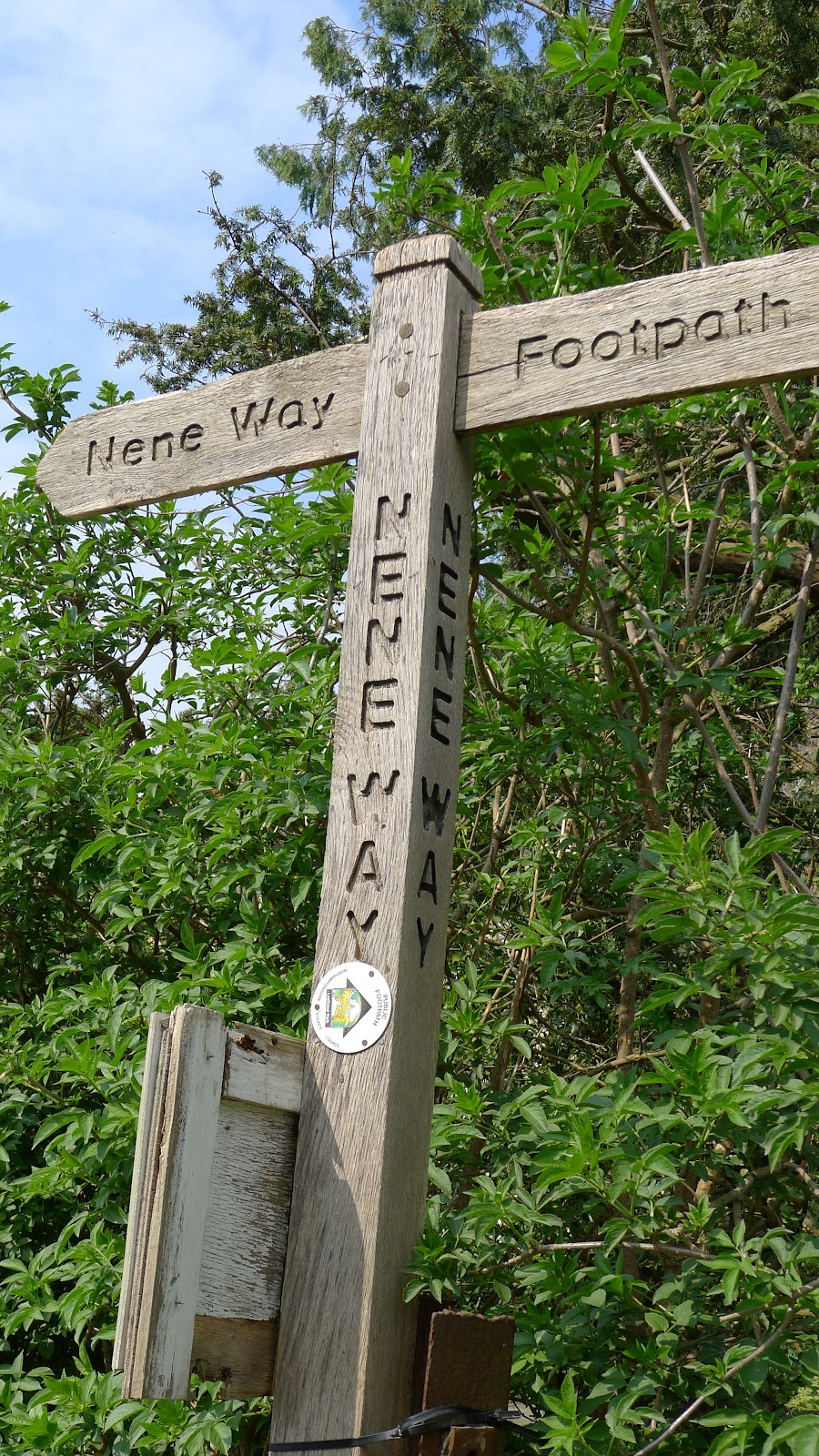
I lost track of the Nene Way at Denford.  It would have taken me on to Islip but I couldn't find it.  So I turned back.

With the weather so hot it seemed like a summer day that would go on and on... but of course the sun was soon on its way down and right in front of me on my way back.  The soft light made the autumn colours glow, playing across the water's ripples and illuminating the translucence of leaves.  A handfull of blackberries kept me from getting too thirsty.

Approaching the bridge again, I saw a swathe of dried thistle heads, the sun light creating a glow around them, like a crowd of faces with little haloes.


Walking from Islip to Titchmarsh the next day, I started walking between lakes and the river.


Formed by the old gravel pits, the lakes are now the Titchmarsh Nature Reserve, and of course abundant with birds.  I often saw a large black bird flying above, which looked like a cormorant to me.  Later on, I heard a rather mournful sound, almost a weeping, from behind the trees near the lake.  Having looked up the sound a cormorant makes, it did sound just like this.


Countless swans covered a lake, as far as you could see.

You feel surrounded by water, lakes to the left and infront, the river on the right.  The sailing club had a wonderful stillness today, being a hot Sunday, everything sitting quietly in symmetry with undisturbed reflections.


Again, walking back the sun was low, shadows long and the light golden.  Colours seemed heightened, bright red thorns against the blue sky.


The weekend had been all about light, the sun bringing alive the leaves, water, shadows, a sense of stillness only animated by the ever changing play of light as the sun gently lowered behind the horizon.

Wednesday, 28 September 2011

The Art of Touch

Thursday saw the launch of a big project I have completed with Leicestershire Artworks, "Touch Table".

The Touch Table is a project coordinated by me with Lisa Webb, Artworks Officer for Leicestershire, commissioning 10 artists to create 20 works which can be explored by touch.


The project complements two other pieces of work we had undertaken previously, the Held in the Hand projects, which commissioned artists to create pieces that can be picked up, held and explored.

These projects can be enjoyed by anybody, but are specifically created for the benefit of people with special needs and people with dementia who would particularly benefit in exploring the sensation of touch.

The Touch Table is a special table that can have various artworks slotted into it.  It holds the art panels so that people can run their fingers across them to feel the textures.  Not only do the artworks include different materials and textures but there are ones that spin using magnets and handles, ones that you can press into and they bounce back, and pieces with buttons, ties and pockets that can be undone and explored.


The launch was a rather grand affair, held at Ulverscroft Manor, with canapes and drinks, and speakers from the local councils as well as Stephen Dorrell MP, Health Minister.

For me, working with Lisa on the brief for artists and then developing ideas with various artists for their specific pieces, it was fascinating to see people's responses to the pieces when they were all laid out together.  Throughout the project, our challenge had been to commission works that were wildly varied yet would create complete sets, covering as many different touch responses as we could, using every possible material, using old skills and new technologies.

Me with some of the artists at the launch.  L to R:  Sue Hague, Dr Lionel Dean, Austin Orwin, Richard Dawson and me.
It was great to see some of the artists finally meet each other, they instantly started to spark ideas off each other!  They, of course, had had no sense of the work of the other artists, they were just deeply involved in their own individual pieces.  Lisa and I were the only ones who had had any vision of how it would all work together, and we could finally see this coming to fruition and being enjoyed by everybody.

Thanks to all the artists who contributed their skills and talent, it is a truly wonderful collection of high quality tactile art.

To find out more about Touch Table and the Held in the Hand pieces, which are available for loan to schools and groups throughout Leicestershire, click here.

Thursday, 15 September 2011

Animated artists, young people and museums and the Ticket Exchange!

A little gap between posts as I have been on holiday.  But here's a little look back at some of the things I am involved with...

Just for a giggle, three of the Associated Artists at Nottingham Contemporary took part in "The World is Your Stage" - the longest stop animation film ever!  A project created by Brendan Oliver & Brendan Randall.   See our contribution and more about the project.


(Influenced by the current Jean Genet exhibition, our piece was about power and role swapping.  Obviously!)

Also, my new project has been launched.  These leaflets are going out across Leicester and Leicestershire inviting young people to take part in an exciting project with New Walk Museum to create new innovative resources for visitors.  Click on the image to see a bigger version.


And most recently, Carole Miles and I have started our Ticket Exchange activity on the trains in Derbyshire for the Undiscovered Networks project, which has been going really well.  We are blogging about the project here.

Friday, 26 August 2011

Following walls

This week I had to present a proposal in Wolverhampton and talk about the beauty of maps.  We began talking about maps as lines to follow, and I have an idea about maps being on walls and linear, like a trail through a building.

They are building a new Leisure Centre and the architectural design is lovely, with curved green walls throughout.  I have started playing with ideas of curved walls and maps that curve around them...

or maps as ribbons...

... maps as three dimensional drawings, taking you on a physical journey as you walk alongside them.

Geographical maps are two dimensional drawings representing a three dimensional space.  What if a map works back in three dimensions, drawn across a space?

Like contours across the space?  Or as a map transposed onto somewhere else?

A walk in the Peak District.  Following walls.


Tuesday, 16 August 2011

Curating walks

I have been thinking about the nature of curating for some time. At Nottingham Contemporary the current exhibition, Jean Genet - The Courtesy of Objects, has been curated in an unusual and interesting way, almost creating a portrait of Jean Genet through a collection of other artists' works.

I have led workshops about curating before at the galleries. It's often the unseen creative process that people forget about. You tend to focus on the artworks and the artists in an exhibition and yet everything you see is also framed by the curatorial concept. The fact that you may not be consciously aware of this as an audience gives a curator a lot of power. It could even be considered manipulative!

Maps from the Wellbeing Walks finished this week and ready to go!
I've started thinking about all the walking and mapping projects that I have been doing for the last few years in terms of curating.

In a sense the mapping process is like the curation of the walk.  A particular walk can take on its own theme.  A map then identifies and draws together the theme or overarching idea about a place or a route and attempts to present this as a coherent truth.

Detail from Myth Maps, Snibston
I have used walks as a way of exploring a place and discovering something of its character, which is then made visible in a map. The process can be transformative and also enables the map maker to develop a quite intimate relationship with a particular place or landscape. 

Detail from Myth Maps, Snibston
I have been talking with LJ, a colleague at the Contemporary who has just finished her Art History degree and is interested in curating and mapping, about exploring some of these ideas further. We hope to propose an action research project some time in the future which will pull together a number of these interests.

Tuesday, 9 August 2011

The grammar of Nature - gift or product?

Richard Mabey explains an important idea about our changing relationship to trees in his book "Beechcombings":

The fundamental grammar of our relationships with trees changed.  Before, 'growing' had been an intransitive verb in the language of woods.  Trees grew, and we, in a kind of subordinate clause, took things from them.  In the forest-speak of the Enlightenment, 'growing' was a transitive verb.  We were the subject and trees the object.  We were the cause of their existence in particular places on the earth.
Mabey thinks that somewhere around the second half of the 17th century the way we refer to trees, the way we speak about trees and woodland, and therefore the way we think about trees, began to change.  And that has changed the way we behave towards trees and how we value them.


I feel this attitude can be applied to all Nature.  Nature changed from being a gift, such as in the act of foraging, where we can seek and find things that we can use and are of value to us, and we rejoice in the finding of these things.  Now Nature seems more like a product, like so many items on a market shelf.  Something we can produce ourselves and "perfect" (whatever that may mean!), something we can acquire.  From Capability Brown's creation of "natural" vistas in landscape design to today's contrived cottage gardens, we have embraced Nature in a strange way which both admires its random beauty and yet seeks to control it.


I love my garden and the careful trimming and pruning of this and that.  I love the joy that I get from a plant that rewards my efforts.  But this is a very different experience to being somewhere like on the River Nene.


In our River Nene project Three Jos in a Boat, we have very much had the sense that we are in another world.  A world of Nature.  A place that we are not of.  A place that has its own rules, rhythms and lives that continue regardless of and indifferent to our existence.  A place where we have little influence.


Man's relationship to Nature (in our Western culture, anyway) has become separated - it is in the grammar we use, the way we speak about things.  Man and Nature.  Two different, separate, opposite nouns.  In gardening and in agricultural practices we spend our time battling with Nature's way to make it work to our own rules.


This may be changing.  Attending a conference in Leeds a few years ago on Design Activism, I met people from the Permaculture Association.  Permaculture is about sustainability, a word we hear all the time these days.  But it is more than that.  It seems to me that the principles of Permaculture are about integration, about us becoming more integrated with Nature's laws once more and becoming a part of that system, instead of our continuing to try to be a dominant and controlling force.

Perhaps we need to change our use of language again.


(All the images in this post are a gift from the River Nene.)