Friday, 26 August 2011

Following walls

This week I had to present a proposal in Wolverhampton and talk about the beauty of maps.  We began talking about maps as lines to follow, and I have an idea about maps being on walls and linear, like a trail through a building.

They are building a new Leisure Centre and the architectural design is lovely, with curved green walls throughout.  I have started playing with ideas of curved walls and maps that curve around them...

or maps as ribbons...

... maps as three dimensional drawings, taking you on a physical journey as you walk alongside them.

Geographical maps are two dimensional drawings representing a three dimensional space.  What if a map works back in three dimensions, drawn across a space?

Like contours across the space?  Or as a map transposed onto somewhere else?

A walk in the Peak District.  Following walls.


Tuesday, 16 August 2011

Curating walks

I have been thinking about the nature of curating for some time. At Nottingham Contemporary the current exhibition, Jean Genet - The Courtesy of Objects, has been curated in an unusual and interesting way, almost creating a portrait of Jean Genet through a collection of other artists' works.

I have led workshops about curating before at the galleries. It's often the unseen creative process that people forget about. You tend to focus on the artworks and the artists in an exhibition and yet everything you see is also framed by the curatorial concept. The fact that you may not be consciously aware of this as an audience gives a curator a lot of power. It could even be considered manipulative!

Maps from the Wellbeing Walks finished this week and ready to go!
I've started thinking about all the walking and mapping projects that I have been doing for the last few years in terms of curating.

In a sense the mapping process is like the curation of the walk.  A particular walk can take on its own theme.  A map then identifies and draws together the theme or overarching idea about a place or a route and attempts to present this as a coherent truth.

Detail from Myth Maps, Snibston
I have used walks as a way of exploring a place and discovering something of its character, which is then made visible in a map. The process can be transformative and also enables the map maker to develop a quite intimate relationship with a particular place or landscape. 

Detail from Myth Maps, Snibston
I have been talking with LJ, a colleague at the Contemporary who has just finished her Art History degree and is interested in curating and mapping, about exploring some of these ideas further. We hope to propose an action research project some time in the future which will pull together a number of these interests.

Tuesday, 9 August 2011

The grammar of Nature - gift or product?

Richard Mabey explains an important idea about our changing relationship to trees in his book "Beechcombings":

The fundamental grammar of our relationships with trees changed.  Before, 'growing' had been an intransitive verb in the language of woods.  Trees grew, and we, in a kind of subordinate clause, took things from them.  In the forest-speak of the Enlightenment, 'growing' was a transitive verb.  We were the subject and trees the object.  We were the cause of their existence in particular places on the earth.
Mabey thinks that somewhere around the second half of the 17th century the way we refer to trees, the way we speak about trees and woodland, and therefore the way we think about trees, began to change.  And that has changed the way we behave towards trees and how we value them.


I feel this attitude can be applied to all Nature.  Nature changed from being a gift, such as in the act of foraging, where we can seek and find things that we can use and are of value to us, and we rejoice in the finding of these things.  Now Nature seems more like a product, like so many items on a market shelf.  Something we can produce ourselves and "perfect" (whatever that may mean!), something we can acquire.  From Capability Brown's creation of "natural" vistas in landscape design to today's contrived cottage gardens, we have embraced Nature in a strange way which both admires its random beauty and yet seeks to control it.


I love my garden and the careful trimming and pruning of this and that.  I love the joy that I get from a plant that rewards my efforts.  But this is a very different experience to being somewhere like on the River Nene.


In our River Nene project Three Jos in a Boat, we have very much had the sense that we are in another world.  A world of Nature.  A place that we are not of.  A place that has its own rules, rhythms and lives that continue regardless of and indifferent to our existence.  A place where we have little influence.


Man's relationship to Nature (in our Western culture, anyway) has become separated - it is in the grammar we use, the way we speak about things.  Man and Nature.  Two different, separate, opposite nouns.  In gardening and in agricultural practices we spend our time battling with Nature's way to make it work to our own rules.


This may be changing.  Attending a conference in Leeds a few years ago on Design Activism, I met people from the Permaculture Association.  Permaculture is about sustainability, a word we hear all the time these days.  But it is more than that.  It seems to me that the principles of Permaculture are about integration, about us becoming more integrated with Nature's laws once more and becoming a part of that system, instead of our continuing to try to be a dominant and controlling force.

Perhaps we need to change our use of language again.


(All the images in this post are a gift from the River Nene.)

Monday, 1 August 2011

River Foraging

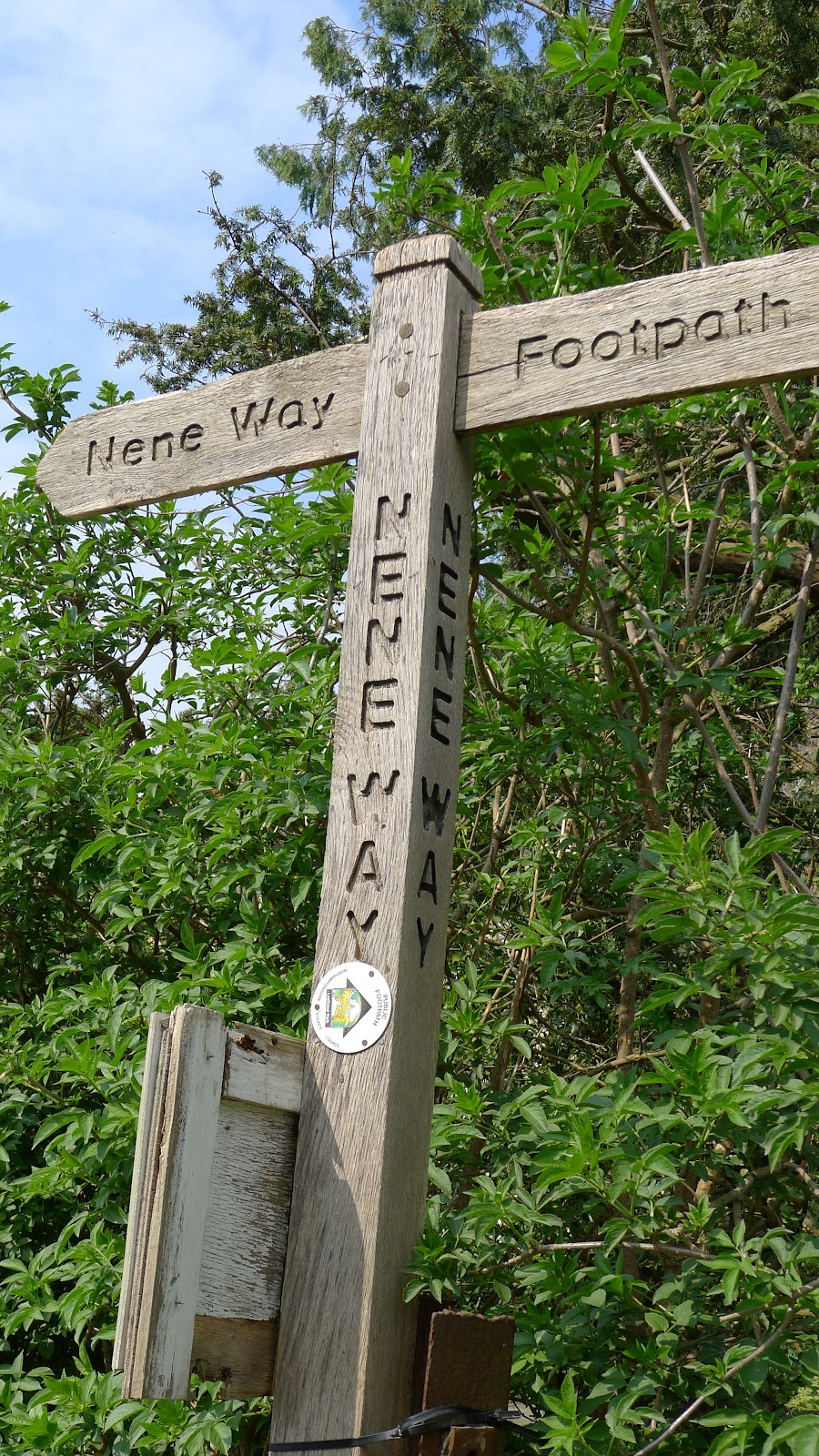
I have been walking along parts of the River Nene, sometimes accompanied by photographer Kate Dyer, for our Three Jos in a Boat project celebrating "BB".


Alwalton was the furthest point that BB reached in his book "A Summer on the Nene".  The village is beautiful, very quiet, with a few unusual buildings.  Two footpaths to the river, one which takes you to a bend which seemed shallow enough to wade, the other taking you to Alwalton Lock.

The plaque reads "Henry Royce, co-founder of Rolls-Royce, born in Alwalton 1863

There are in fact two locks here.  Alwalton Lock is prominent on the landscape and there were many people around walking their dogs.

 
But following the path towards the other lock that can be seen in the distance, you enter into a cool woodland area and stumble across the most remarkable eerie green pool.  A small boat tucked away at the side. 


The way the light came through the trees and lit up the green algae was quite astonishing.


Follow the path the other way across the field and footbridge reveals further interest.  Wild flowers growing up to the side of the water, a splattering of bright colours.


One bank completely clothed in these bright yellow daisies


A conical building in the distance... at first I wondered if it was a kiln, but approaching it closer the windows suggested an old mill or store, perhaps?


At the other end of BB's route, Kate and I explored the area around Higham Ferrers and Ditchford.  On the map it was apparent that there were lakes scattered around the river in this area.  It appears that the lakes were formed by the abandoned gravel pits, where gravel was once quarried.  We wondered how this landscape would have been when BB came by here, would the quarrying still have been underway and would this have been a bustling industrial site?  Did BB write about this or was he only interested in the more picturesque?

Only occasional glimpses of the gravel pit lakes through the trees
BB did bemoan the fact that the countryside and natural things all around him were giving way to "progress".
"Look ye also, while it lasts." 
Perhaps he would have been heartened to know what we found:  as the industry has disappeared, nature has moved back in in the way that it does and is thriving!  The Higham Ferrers path is quite hard to find, but once on it there is a Nature Reserve and a haven of foraging potential!  We found (and sampled!) a great variety of berries coming into ripeness.  A little early perhaps?

Plums, sweet and juicy

Blackberries, abundant and delicious!

Sloes, just turning blue
We were heading for a bridge marked on the map but when we got there the bridge was unsafe to cross.  An elderberry bush had claimed it for its own and grew right up through the middle!


The bridge seen from the opposite side

Walking to the bridge from the other end, approaching from Ditchford, through a small holding with sheep and lovely chickens, past the sewage works, the area has none of the romantic elegance of some of the village areas that we have visited along the River.
 
Once you get back to the river, the roar of the traffic running right parallel to the river is deafening.  Driving on that stretch of road, you could easily be completely unaware that there is a river just a few yards away!  Lorries could be glimpsed trundling by behind the trees.


But still by the river nature carries on, millions of small creatures and plants living out their lives in parallel to ours, regardless of the road.


Sunday, 24 July 2011

Hand made

I finished the Play & Learn Resource packs for Nottingham Contemporary.  There are six packs, all delivered to the Contemporary and already being shown to various potential users.


Also, in my collaborative project Undiscovered Networks, Carole and I are just about finished making the maps as a result of the Wellbeing Walks project (visit the blog for the full story).

 
Hand drawing maps for Wellbeing Walks
There is something about the handmade that is special.  The Play & Learn packs have been well received so far, partly because of the tactile quality of them as they have been hand printed.  You can feel (and still smell!) the textures of the inks, the green is smooth to the touch, the cotton fabric is rougher, the gold colour has a slight sheen.  They feel substantial in the hand, and each one is slightly different and unique.

Although we are having to reproduce all our items for the Undiscovered Networks project, Carole and I did agree from the beginning that we wanted everything to have been hand made originally and to look that way.

Hand printing with Carole for Undiscovered Networks
There is something I like about making things that are intended for the corporate and branded but making them by hand, putting my own spin on it (Nottingham Contemporary has its own distinct branding look, and in Undiscovered Networks we are responding to the branding of the rail companies).  Instead of the polished, perfect look of the digital and reproductive print, the hand made has that personal touch.  With the Play & Learn packs I've stayed within the branding guidelines but everything is slightly off-set, the motifs are repeated but in a different sequence each time, the edges are sometime slightly blurry and you can tell that everything is hand cut.


The result is something that seems friendly, softened, that seems to carry my signature, or my "touch".  Somehow I feel this puts me in touch with the people who might pick it up and use it.  I introduced the packs to a group of family tutors last week, and just watching them open up the pockets and explore the packs, stroking the tactile surfaces with their fingers, somehow I felt the fact that I made these with my own hands and then passed them into their hands gave me a closer connection to the way they will be used.

It's exciting to launch something like this into the world.  I shall be watching with interest who uses them and how.

Thursday, 14 July 2011


I am working on making new Resource Packs for Nottingham Contemporary.

They are going to trial this as an idea for visitors with children to the galleries.  They can pick up one of these fabric packs and use them to explore the exhibitions in a playful way.

Because I need to make several of them, I decided to screen print them.  Made of cotton, they unfold into a big mat that families can sit on in the galleries.  The mat will have several pockets containing objects, textures, and ideas for exploring the exhibition.

They're taking longer to make than I had anticipated!  But it's really good to be screen printing again.  At the moment the packs are half printed and hanging all around my studio.  I'm quite enjoying the abstract compositions that they make hanging up.


I'm also making each one slightly different, and I want it to be obvious that it is hand made rather than machine made.  I'll be layering other patterns on top.  Each one will be unique.


Not just a resource pack, but a unique piece of hand crafted art to play with when you visit the galleries.  Should be fun.

Thursday, 7 July 2011

Hills and plains

A busy week, working on projects as diverse as sewing a fabric resource pack for Nottingham Contemporary, printing works for the Undiscovered Networks project and discovering more parts of the River Nene for the Three Jos in a boat project!

The county of Northamptonshire is very flat, hence the River Nene through here moves very slowly.  I discovered that BB visited a longer stretch of the river than I had previously thought, from Wollaston all the way to Alwalton.  So the project director Ros Stoddart and I decided to visit Wollaston to see what it was like.


The map of the River Nene produced by the Environment Agency for river users is interesting.  It focuses on the information that river users need, with just the briefest acknowledgment of surrounding roads.  Locks are more important to river users than towns or roads, these are the points for navigation and location.  This river map gives little information about the shape of the landscape around it.

So walking down from the hill from Great Doddington towards the river we suddenly become aware of how wide the river valley is.  As the village is up on a hill you get a marvelous view of the river below and some of the lakes around it.

I started to compare this with the experience I had had when travelling on the river as the Three Jos back in May and June.  When on a boat you feel incredibly "placed" with the river, the experience is very much on one plane.  So it was quite startling to see the river as part of a wider landscape and become aware of its valley.

The river from the boat.  Still waters.
Ideas for the River map are coming on well and I hope to do quite a lot of work on this over the next few weeks.